Best Solar Bird Feeder Cameras (2026): Built-In Roofs vs Separate Panels
Our top picks
 Best overall solar feeder: built-in panel, 9,000 mAh battery, 4K and free ID, about $220Birdfy Metal 2 4K Smart Bird Feeder4K · Free AI ID · Built-in solar roof8.5Price tier: PremiumCheck price on Amazon
 Strongest built-in solar: 4.4 W dual-panel roof, removable 5,200 mAh battery, 4K, about $170Kiwibit Bird Feeder 2 Solar 4K HDR4K · AI ID needs a plan · Built-in solar roof7.9Price tier: Mid-rangeCheck price
 Neatest solar roof: Bird Buddy's proven all-in-one design, 3,800 mAh, about $239Birdbuddy Pro Solar Smart Bird Feeder2K · AI ID needs a plan · Built-in solar roof8.0Price tier: PremiumCheck price
 Biggest panel: 5 W solar for a two-camera, three-lens feeder, about $330Birdfy Feeder 2 Duo (Two Cameras, Three Lenses)2K · 3 lenses · Free AI ID · Solar panel included8.0Price tier: FlagshipCheck price
 Best value with solar in the box: 3 W panel, 9,000 mAh battery, free ID, about $130Birdfy Feeder 2 (Solar)1080p · Free AI ID · Solar panel included7.8Price tier: Mid-rangeCheck price
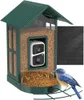 Cheapest: 5 W panel and 5,000 mAh battery on a 2.7 L feeder, about $59Soliom BF08 2K Smart Bird Feeder (Solar)2K · AI terms unclear · Solar panel included7.1Price tier: BudgetCheck price
Solar is the feature that turns a smart feeder from a gadget you babysit into one you forget about. Without it, you’re taking the camera down every few weeks to charge it, usually when it’s cold or raining. With a good panel in a sunny spot, several reviewers went months without touching a cable.
But solar setups differ more than listings suggest. Some feeders build the panel into the roof; others ship a separate panel on a cable. Wattage ranges from 3 W to 5 W, and battery capacity, your buffer for cloudy weeks, ranges from 3,800 to 9,000 mAh. We haven’t tested these feeders ourselves. The solar results below come from The Gadgeteer, MacRumors and Digital Camera World, and specs from the makers. Prices are Amazon’s on November 12, 2026.
Solar shortlist
| Feeder | Solar | Panel | Battery | Video | Price (Nov 12) |
|---|---|---|---|---|---|
| Birdfy Metal 2 4K | Built in | Wattage not listed | 9,000 mAh | 4K | $219.99 |
| Kiwibit Solar 4K | Built-in roof | 4.4 W | 5,200 mAh (removable) | 4K | $169.98 |
| Birdbuddy Pro Solar | Built-in roof | Not listed | 3,800 mAh | 2K | $239 |
| Birdbuddy Home | Dual roof panels | Not listed | 3,900 mAh | 2K | $199 (Bird Buddy store) |
| Birdfy Feeder 2 Duo | Separate | 5 W | Not listed | 2K + 1080p ×2 | $329.99 |
| Birdfy Feeder 2 | Separate | 3 W | 9,000 mAh | 1080p | $129.97 |
| Soliom BF08 | Separate | 5 W | 5,000 mAh | 2K | $58.99 |
Built-in roof or separate panel?
Built-in roofs (Bird Buddy, Kiwibit, Birdfy Metal 2 4K) have no cable to route, nothing to chew and a cleaner look. MacRumors’ reviewer prefers Bird Buddy’s all-in-one design for exactly that reason. The limitation is that the feeder and the panel are in the same place, so a feeder tucked under a tree for the birds’ comfort also shades its own panel.
Separate panels (most Birdfy models, Soliom, birdsnap, Perky-Pet, Humbirdy) plug into the camera on a cable. MacRumors notes the Birdfy panel can be positioned a couple of feet away, and the birdsnap TUC’s cord is 9.8 ft. That lets you put the feeder near cover, which birds like, and the panel in full sun. The cost is a cable that squirrels can chew and a messier look.
If your best feeder spot is shady, a separate panel is the safer choice. Check your exact spot with the placement checker.
Best overall: Birdfy Metal 2 4K
The Birdfy Metal 2 4K pairs a built-in panel with a 9,000 mAh battery, the largest here, which gives more headroom through gray spells. It also has 4K video, free unlimited ID, dual-band Wi-Fi and a metal body that Tom’s Guide found squirrels couldn’t get through. Birdfy doesn’t list the panel wattage. It was $219.99 on Amazon.
Strongest built-in solar: Kiwibit Solar 4K
The Kiwibit Solar 4K has two 2.2 W panels in its roof for 4.4 W total, which The Gadgeteer called the highest integrated solar wattage it had seen on a smart feeder. In its Texas spring test the battery hovered between 70% and 95%, and recovered from 30% to above 85% in two days of sun. The 5,200 mAh battery is removable, so you can swap it during a long cloudy stretch without taking the feeder down.
Two caveats from The Gadgeteer: its test was in strong spring sun, and turning on 3-minute extended 4K clips (a Premium feature) can drain the battery in under a week even with the roof. ID needs Kiwibit Premium unless you buy the Lifetime AI version. The base model was $169.98.
Neatest solar roof: Bird Buddy
The Birdbuddy Pro Solar is the classic all-in-one: the panel is the roof. Its battery is smaller at 3,800 mAh, so it leans more on daily sun. The newer Birdbuddy Home uses dual panels, which Digital Camera World said almost remove the need for charging in standard power mode. Bird Buddy’s Nook page explains its power management: after several cloudy days the feeder lowers motion sensitivity to save power, then restores it when the sun recharges it. Automatic ID on all Bird Buddies needs Premium ($69.99 a year). The Pro Solar was $239 on Amazon.
Biggest panel: Birdfy Feeder 2 Duo
Two cameras use more power, so Birdfy ships the Feeder 2 Duo with a 5 W panel and a split USB-C cable. MacRumors’ Duo sat in a spot with little direct sun and needed manual charging twice, a reminder that wattage can’t beat shade. It was $329.99.
Best value and cheapest
The Birdfy Feeder 2 includes a 3 W panel and a 9,000 mAh battery for $129.97, with free ID. MacRumors’ experience with Birdfy’s solar panel on the Classic is encouraging: in a spot with morning and afternoon sun it never dropped below 90%, though one in a wooded area hovered around 50%.
The Soliom BF08 is the cheapest solar feeder we track at $58.99, with a 5 W panel and 5,000 mAh battery, per its listing. We found no independent test.
What drains a solar feeder
- Livestreaming. Watching live keeps the camera and Wi-Fi radio on continuously. A few minutes a day is fine; leaving a stream open isn’t.
- Long or high-resolution clips. The Gadgeteer’s warning about 3-minute 4K clips applies to every brand.
- Busy feeders. Every visit wakes the camera. A feeder with 70 visits a day uses far more power than one with 10.
- Weak Wi-Fi. A camera fighting for signal spends more power transmitting. Our Wi-Fi troubleshooting guide helps.
- Winter. Shorter, lower sun, snow on the panel and cold batteries all cut the margin:
Winter sun is lower and shorter, so solar panels deliver far less. Angle the panel toward the low southern sky and clear snow off it.
Lithium batteries deliver less in deep cold and many shouldn't be charged below freezing. Check your feeder's rated range: Bird Buddy lists -5°F, Kiwibit -4°F, Birdfy's 2 Pro 14°F.
Bird Buddy lowers motion sensitivity after several cloudy days; turning down livestreaming and clip length helps every brand.
Bring the camera in to charge over USB-C during long gray spells, or swap a removable battery (Kiwibit).
More detail in do smart bird feeders work in winter?
Adding or upgrading a panel
If your camera charges over USB-C, you can add solar to a feeder that shipped without it, or upgrade a weak panel. These are third-party panels sold for bird feeder cameras:
| Item | Type | Fits | Buy |
|---|---|---|---|
| 3 W USB-C solar panel for bird feeder cameras, 360° swivel bracket Adds solar to a USB-C camera feeder that shipped without a panel, or replaces a damaged one. | Solar | Birdfy Classic, Birdfy Feeder 2, Camojojo Hibird 4K (Check your camera charges over USB-C and that the cable reaches a sunny spot; a weatherproof port cover matters.) | Check price |
| 5 W USB-C solar panel for Birdfy feeder cameras, 360° adjustable mount More wattage for shady yards and short winter days, where a 3 W panel can't keep up with a busy two-camera feeder. | Solar | Birdfy Feeder 2, Birdfy Feeder 2 Pro, Birdfy Feeder 2 Duo, Birdfy Classic (Third-party; sold as compatible with Birdfy cameras.) | Check price |
| SanDisk 64GB High Endurance microSDXC card Local recording without a cloud plan, and a backup when Wi-Fi drops. High Endurance cards are rated for continuous camera writes. | Storage | Kiwibit Solar 4K, Kiwibit 2 Mini, birdsnap TUC (Only feeders with a microSD slot. The birdsnap TUC ships with a 32 GB card; this is a larger spare.) | Check price |
Mount the panel facing the sun’s path (south in the US), tilted more steeply in winter, and keep it clear of leaves and snow.
How to aim a feeder panel
- Face it toward the sun’s path, which is south across the US.
- Tilt it more steeply in winter, when the sun is lower; a near-flat roof panel loses most in December.
- Check the spot at different times of day: a panel that’s sunny at noon may be shaded by a tree or house for the rest of the day.
- Keep it clean. Pollen, leaves, bird droppings and snow all cut output.
- On separate panels, route the cable where squirrels can’t chew it and keep the USB-C connection covered.
Verdict
For most yards, the Birdfy Metal 2 4K is the best solar feeder: built-in panel, the biggest battery and free ID. Choose the Kiwibit Solar 4K for the strongest roof panel and 4K for less, and Bird Buddy if you want the neatest all-in-one design and its app. In a shady yard, pick a feeder with a separate panel so you can chase the sun.
See the full ranking in the best bird feeder cameras of 2026, and read where to place a bird feeder camera before you mount anything.
Frequently asked questions
Do solar bird feeder cameras really never need charging?
Is a built-in solar roof better than a separate panel?
How many hours of sun does a feeder solar panel need?
Can I add solar to a feeder that didn't come with it?
Do solar feeders work in winter?
Sources
- The Gadgeteer: Kiwibit Bird Feeder 2 review · checked 2026-11-12 — Dual 2.2 W panels make a 4.4 W roof; battery hovered between 70% and 95% in sunny Texas spring weather and recovered from 30% to above 85% in two days of sun.
- MacRumors: Birdfy Feeder and Feeder 2 Duo review · checked 2026-11-12 — A solar Birdfy Feeder with morning and afternoon sun never dropped below 90%; one in a wooded area hovered around 50% and needed one winter charge; the shaded Duo needed manual charging twice.
- Digital Camera World: Bird Buddy 2 review · checked 2026-11-12 — Exceptional solar efficiency in standard power mode from the integrated roof panels.
- Bird Buddy: Birdbuddy Nook Solar product page · checked 2026-11-12 — The system lowers motion sensitivity after several cloudy days to conserve power, then restores it when sunlight recharges the battery.
- Amazon: Birdfy Metal 2 4K Smart Bird Feeder · checked 2026-11-12 — Built-in solar panel and 9,000 mAh battery, 4K camera, 2.4/5 GHz Wi-Fi, IP66; $219.99.
Get new guides by e-mail
One short e-mail when Bird Feeder Camera Guide publishes a new guide. No spam, no sharing your address, and you can unsubscribe in one click.